
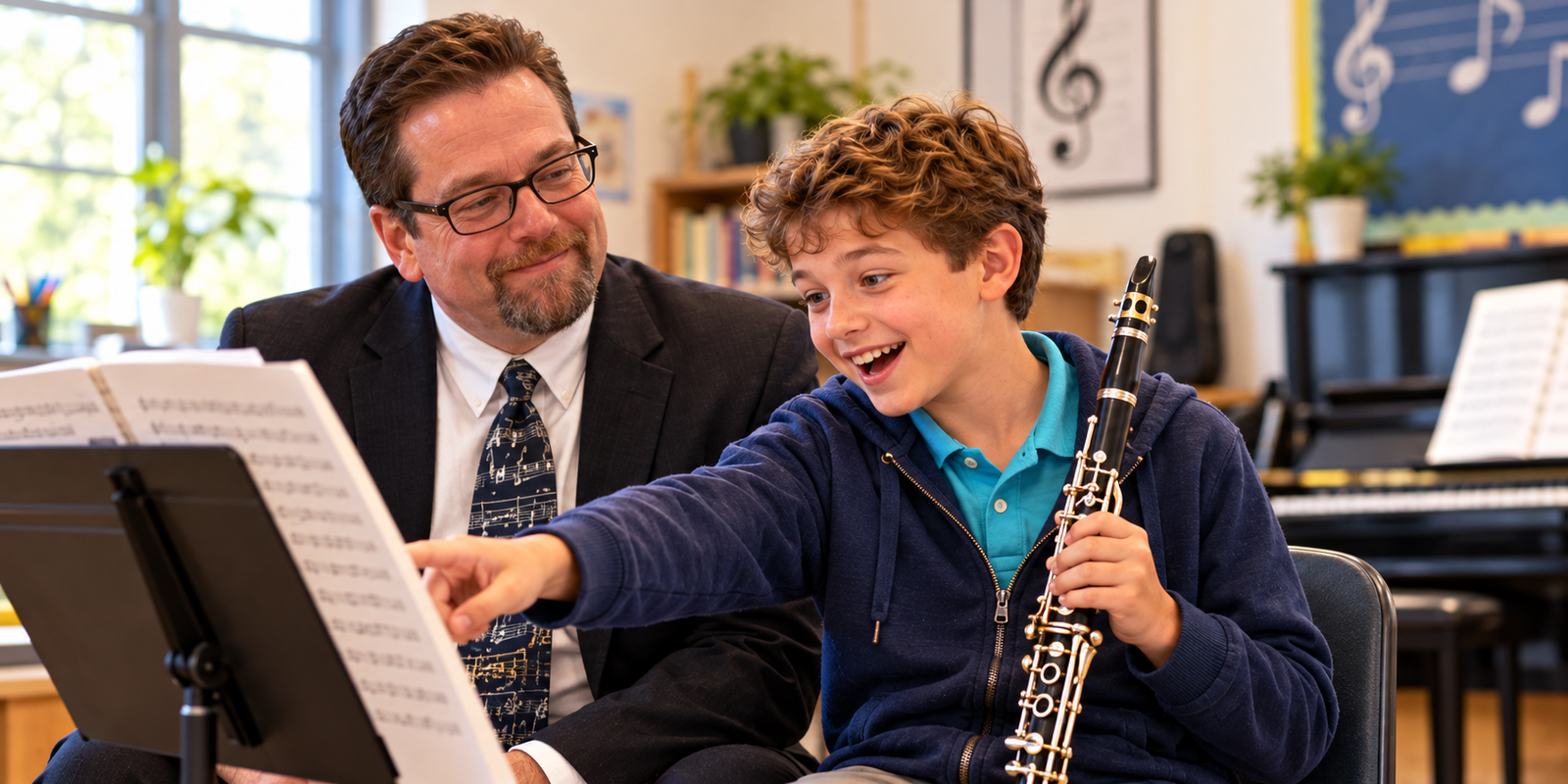
Your child opens an instrument case, pulls out a folder of music, or starts singing a song from choir. You want to help—but you don’t read music. Maybe your own musical experience ended years ago. Perhaps you’ve always described yourself as someone who “can’t carry a tune.”
Here’s the good news: you do not need to be a musician to be an important part of your child’s musical experience.
At the Homeschool Music Academy, we want parents to feel like partners, not substitute music teachers. You don’t have to identify a wrong note, demonstrate a bow hold, or explain a time signature. Your most valuable contribution is encouragement—along with a little structure, curiosity, and willingness to listen.
Be the Parent, Not the Second Director
It can be tempting to turn every practice session into a lesson, especially when you hear something that doesn’t sound quite right. But you don’t need to diagnose every squeak, missed entrance, or uncertain note.
Instead, help your child connect home practice to the teacher’s instructions.
Try asking:
- “What did your director ask you to work on this week?”
- “Can you show me which part you’re practicing?”
- “Is there something you want to ask about at your next class?”
If your child doesn’t know what to do, that’s useful information to share with the instructor. You don’t have to invent an assignment or search online for a competing explanation. A simple question to the director can help clarify the next step.
Your role is to support the learning—not to take responsibility for teaching everything yourself.
Make Room for Music in the Week
Homeschool families know how quickly a day can fill up. Academic work, errands, meals, activities, and sibling needs all compete for attention. Music can easily become something everyone intends to get to “later.”
Help your child choose a predictable place for music in the family routine. Perhaps it comes after lunch, before a favorite activity, or during a quieter part of the afternoon.
The space does not have to be elaborate. A chair, appropriate music stand, necessary materials, and room to work may be all that’s needed. Follow the director’s guidance about equipment and setup.
For singers, being ready might mean having their music folder, lyrics, and any teacher-provided recordings available.
The goal isn’t a perfect music room. It’s making the first step easy enough that getting started doesn’t become the biggest task.
Ask to Hear Something Small
“Play all your music for me” can feel like a big request. So can “Sing the whole song.”
Instead, invite your child to share one manageable thing:
- “Show me a rhythm you learned.”
- “Can I hear your favorite part?”
- “What’s one thing you can do now that felt tricky before?”
- “Teach me one music word from class.”
You’re not conducting an audition. You’re giving your child an interested audience.
Some children will eagerly demonstrate everything. Others may prefer to share briefly or privately. Let the invitation stay friendly rather than turning it into an unexpected performance requirement.
Notice More Than the Finished Sound
When you attend a concert, you hear the result. At home, you hear the work in progress—and that can be a very different experience.
Instead of listening only for a polished performance, notice the actions your child is taking.
Did they get their materials ready without a reminder? Return to a difficult section instead of skipping it? Remember an instruction from class? Ask for help when something was confusing?
You can respond specifically:
“You went back and tried that section again.”
“I noticed you checked your music before you started.”
“You remembered what your director asked you to work on.”
These observations give you something genuine to say without deciding whether the musical result was technically correct.
You don’t have to call every attempt “perfect” to show that you value the effort.
Let Your Child Be the Expert Sometimes
One enjoyable way to participate is to let your child teach you something.
Ask what a symbol means, how an instrument makes its sound, or why the choir stands a certain way. You might ask:
“What does that mark tell you to do?”
“What are you watching for when the director raises a hand?”
“What’s the difference between singing the melody and singing another part?”
If your child isn’t sure, you’ve discovered a question to bring to class—not a reason for embarrassment.
You can be curious together. A parent saying, “I don’t know; let’s find out,” leaves room for learning without pretending to have all the answers.
Stay Connected to the Instructor
You don’t need to wait until there is a major problem to ask a question.
A brief message can be helpful when your child seems unsure about an assignment, repeatedly struggles with the same task, or becomes frustrated about participating.
Be specific: “She isn’t sure which section to practice,” gives the instructor a clearer starting point than, “Practice isn’t going well.”
Likewise, let the director know about relevant concerns rather than expecting your child to explain everything independently. Keep the conversation collaborative: you’re sharing what you see at home, and the instructor can share what happens in rehearsal.
Try This This Week
Ask your child this simple question:
“What’s one thing from music class you could show me?”
Then give them a few minutes of your attention. Put down the phone, listen, and ask one interested follow-up question.
You don’t need to evaluate the performance. You don’t need to know the terminology. You simply need to communicate, “What you’re learning matters to me.”
That is a meaningful contribution to your child’s musical life—and it requires no musical background at all.